
How Tables finds mobile numbers
Updated
No single data provider has everyone's mobile number. Each one has gaps, and they're in different places. So Tables doesn't rely on one. It asks a first provider, and when that one has no number for a person, it asks the next.
That's the whole trick, and it adds up. Here is what it did in practice:
The first lookup found a mobile for 75.9% of people. Going to the next provider made a big difference: it found a number for more than half of the people the first one missed. Together: 89.4%, or about 9 in 10.
After that, each extra provider adds less. It can only search the people who are still left, and they are more and more often people whose mobile isn't listed anywhere.
The first lookup only returns numbers its provider has verified, so 85% of the numbers Tables found were verified before you got them.
What happens when you look someone up
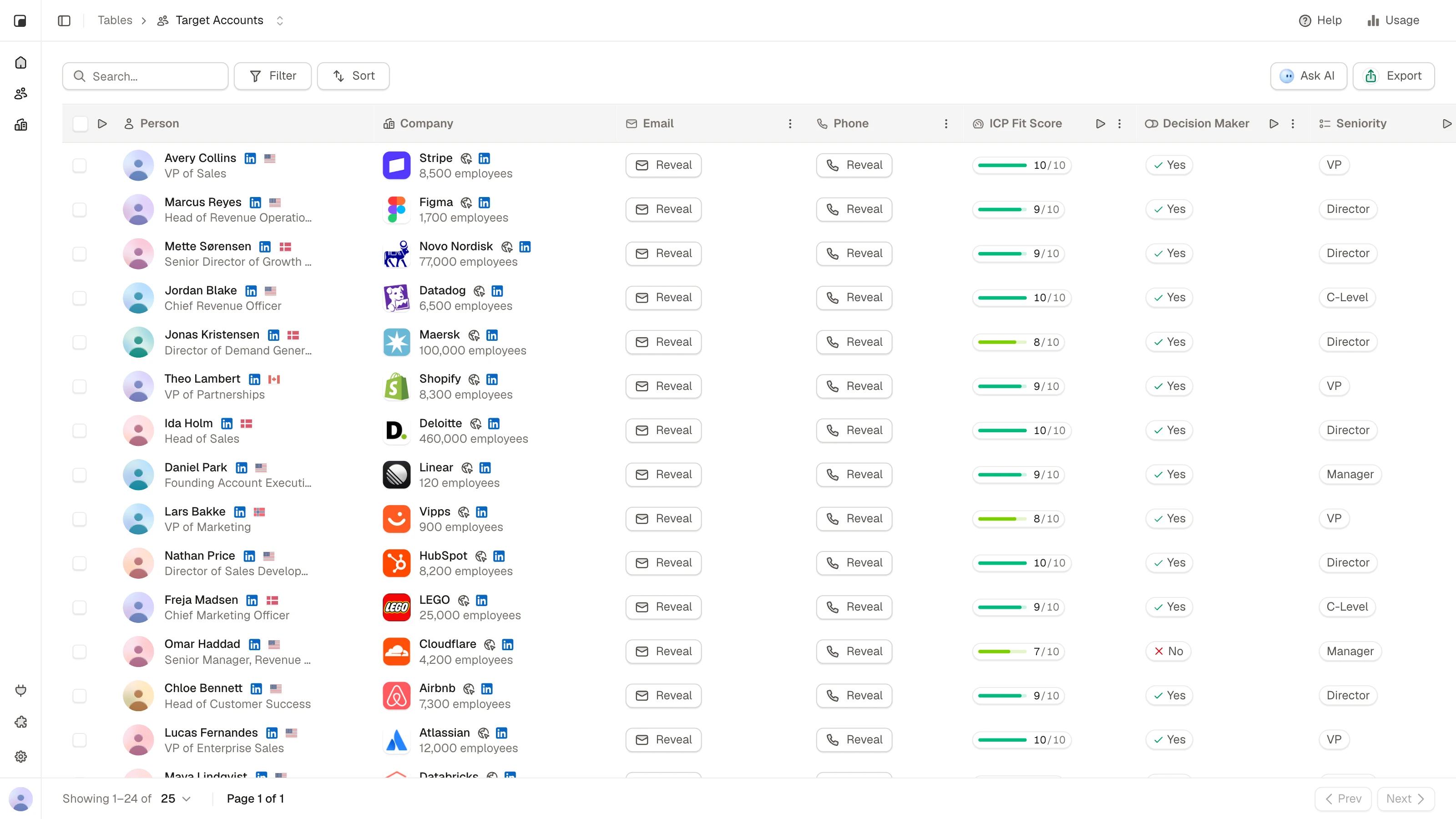
You describe who you want to call, say "heads of sales at Danish logistics companies with 50 to 200 employees", and Tables finds the people who match. When you ask for a mobile, it checks the opt-out list first. Anyone who asked to be removed is never looked up.
Then it asks the providers, one after the other, and stops at the first number it gets. Every number is checked to be a real, dialable number for its country and saved in international format (+45 …), ready for your dialer or CRM.

When a number is wrong
It happens. People change jobs and numbers. Report it from the table, and we review it. Once we remove a number, it's never returned for that person again, for you or for any other customer.
What the 89.4% means
It's a find rate: how often Tables came back with a mobile. It isn't the same as how often the right person picks up, which takes a call test to measure. We think the find rate is the number to compare first, because a number you never get is a call you never make. The full method, and the numbers by country, are in our study of 5,000 lookups.
Privacy
Tables is built in Aarhus, Denmark, and processes business contact details for B2B sales under GDPR. Anyone can ask to be removed by writing to privacy@tables.so. Our privacy policy and sub-processors have the details.
Questions
How often does Tables find a mobile number?
In a random sample of 5,000 lookups from October and November 2026, Tables found a mobile for 89.4% of people: 89.0% in Denmark and 91.0% outside it.
Where do the numbers come from?
From established B2B data providers, asked in turn for each person, so a gap at one is often filled by the next.
What if a number is wrong?
Report it from the table. We review every report, and a number we remove is never returned for that person again, for any customer.
Are these business numbers?
Yes. Tables is for B2B: the direct mobiles of decision makers in their work role.