
We took a random sample of 5,000 mobile number lookups from Tables customers, made between 1 October and 9 November 2026. Tables found a mobile number for 4,472 of them: 89.4%, or about 9 in 10. Most customers sell in Denmark, where it was 89.0%. Outside Denmark it was 91.0%.
Mobile find rate by country
Each bar is the share of lookups where Tables returned a mobile number, for every country with at least 50 lookups in the sample.

| Category | Mobile found |
|---|---|
| Norway | 98.4% |
| Sweden | 94.1% |
| US | 89.6% |
| Netherlands | 89% |
| Denmark | 89% |
| UK | 73.9% |
| Country | Lookups in the sample | Mobile found |
|---|---|---|
 Norway | 428 | 98.4% |
 Sweden | 237 | 94.1% |
 US | 67 | 89.6% |
 Netherlands | 91 | 89.0% |
 Denmark | 3,879 | 89.0% |
 UK | 138 | 73.9% |
Denmark is 78% of the sample, so we show the rest separately as well. The UK, the Netherlands and the US have fewer than 150 lookups each, so treat their numbers as a rough guide.
Why asking more than one provider matters
No single data provider has everyone's mobile number. When the first provider Tables asks has no number for a person, Tables asks the next. This is called waterfall enrichment. Here is the same sample with only the first provider, and with the full waterfall.
| Category | Mobile found |
|---|---|
| One data provider | 75.9% |
| With waterfall | 89.4% |
With one provider, 75.9% of lookups found a mobile. With the waterfall, 89.4%: going to the next provider found a number for 56% of the people the first one missed. After that, each extra provider adds less, because the people still left are more and more often people whose mobile isn't listed anywhere. The first lookup only returns numbers its provider has verified, so 85% of the mobiles Tables found in this sample (3,795 of 4,472) were verified by the provider before delivery.
What other vendors publish
Other vendors publish their own figures, but each one measures something different on different people, such as hard-to-find profiles or lists with no region given. Our sample is 78% Danish. So this is context, not a ranking: the only fair comparison is the same list of people run through each tool.
| Vendor | Published figure | Based on |
|---|---|---|
 Tables | 89.4% of lookups found a mobile | Random sample of 5,000 customer lookups, Oct–Nov 2026 |
 Clay | About 30% with one provider, 80% or more with its waterfall | Clay's own claim, no region or method |
 Cognism | 70% mobile coverage for decision makers in Europe's top economies | Cognism's own claim, October 2025 |
 Surfe | 65.7% of mobiles found (FullEnrich: 57.9%) | 1,000 hard-to-find profiles, Surfe's own test, March 2026 |
 FullEnrich | Around 80% (emails and phones together) | FullEnrich's own estimate |
Sources, checked on 10 November 2026: Clay, find cell phone numbers; Cognism, product marketing update Q3 2025 (14 October 2025); Surfe, Surfe vs FullEnrich; FullEnrich, pricing.
How we measured it
- Sample: 5,000 lookups picked at random from all 18,132 mobile number lookups Tables customers made between 1 October and 9 November 2026, after the waterfall went live. They come from 64 customers and 42 countries. The pick is reproducible: we ordered the lookups by a hash of each record's id.
- What counts: a lookup is a person Tables tried to find a mobile number for. It counts as found if Tables returned one. Numbers that customers typed in by hand are left out.
- Country: where the person is based, from their own professional profile, not where their company is headquartered.
What this doesn't show
- Whether every number is right. A number can be outdated or belong to someone else. Measuring that takes a call test, which we'd like to run next.
- Your list. Customers chose whom to look up, and 78% were in Denmark. A different list may score differently.
Test it on your own list
The fairest test is your own list. Sign up for free, and your 100 credits cover your first 10 mobile numbers. Read more about how Tables finds mobile numbers.

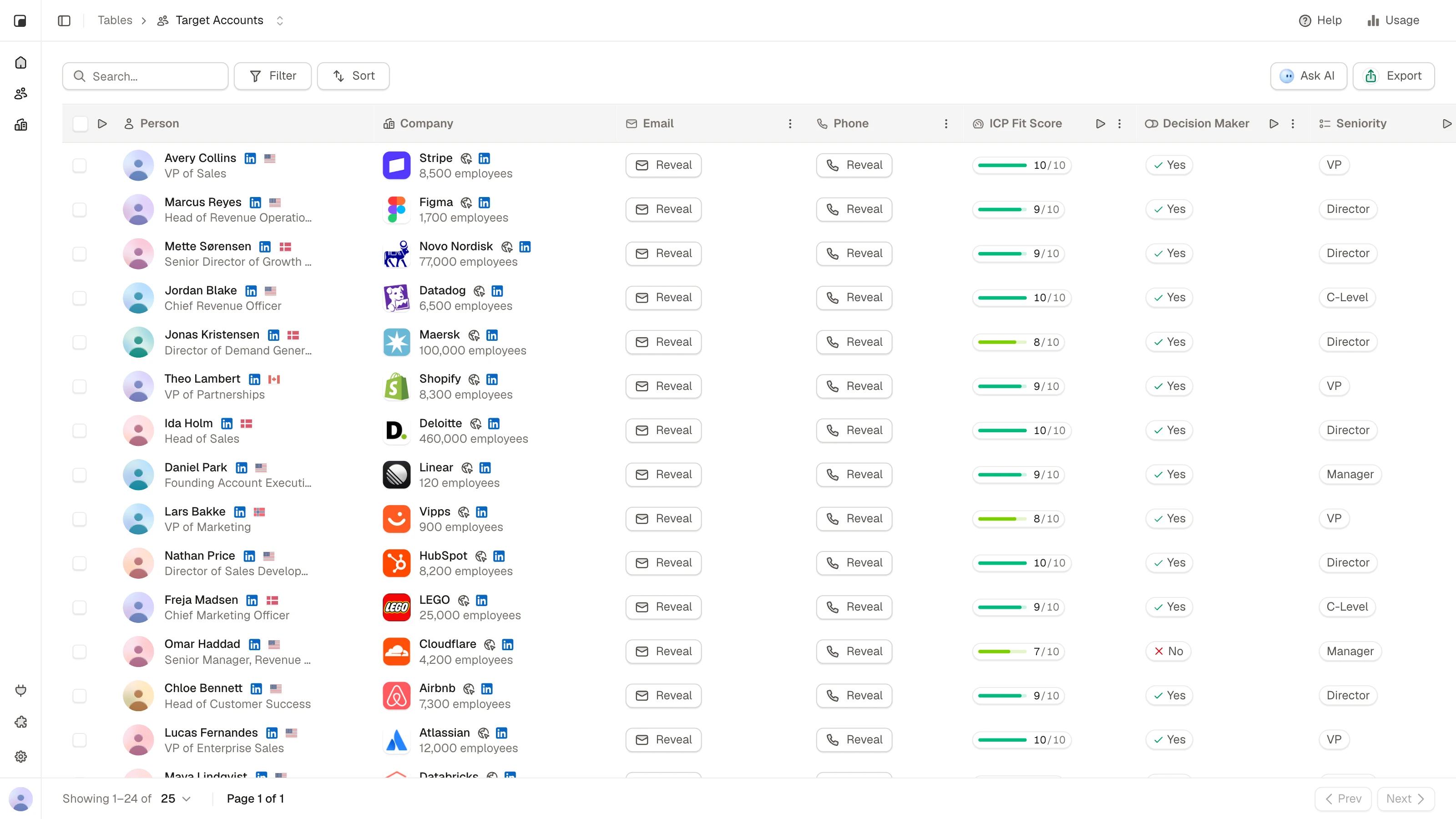
Find the mobile numbers of the people you want to call
Describe who you want to call, and Tables finds the decision makers and their mobile numbers.